Modular Generator architecture
The AI/DC solution uses four modular Generators. Three build the physical fabric — FabricGenerator, PodGenerator, RackGenerator — connecting automatically through checksum-based triggers. A fourth, the OverlayGenerator (generate-tenant), layers EVPN/VXLAN services on top; it uses the same checksum-trigger mechanism but is signaled by tenant design changes rather than by the fabric cascade. This page explains the signaling mechanism, how each tier validates that the previous tier completed, and how interface allocation works.
See Design-driven automation for what the Generators read and produce, or Generator patterns for implementation-level code patterns.
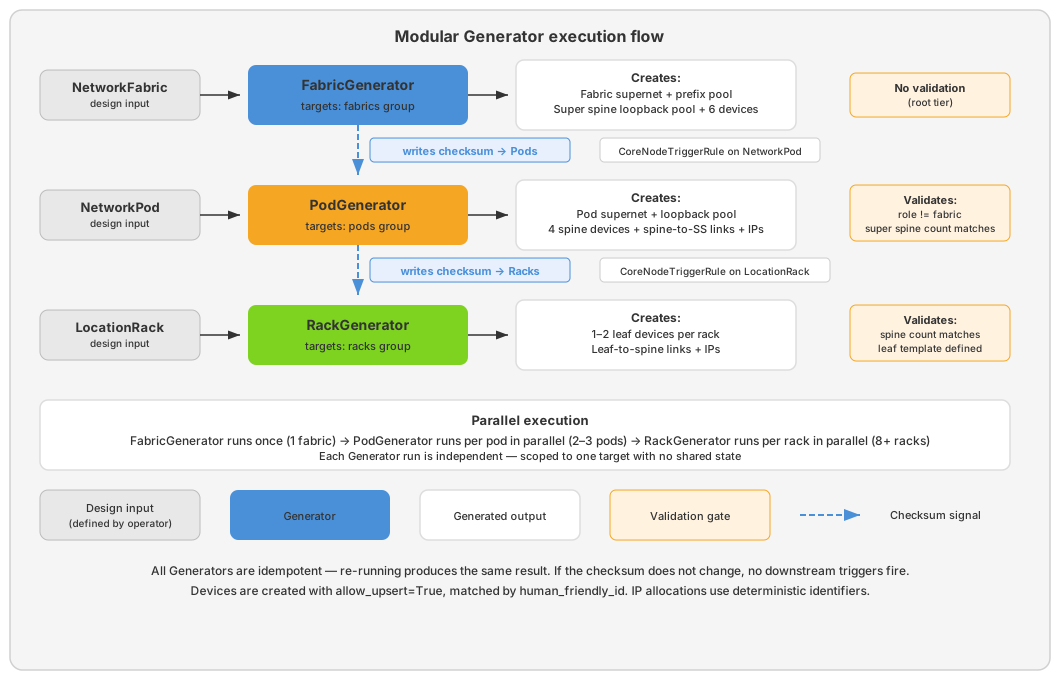
How the modular Generators connect
Checksum-driven signaling
Each Generator writes a checksum to its child objects after it finishes. That checksum change fires a trigger rule, which runs the next Generator tier. The process repeats until the lowest tier completes.
The GeneratorTarget generic (defined in schemas/generator.yml) adds a checksum attribute to both NetworkPod and LocationRack. This attribute is the only thing that flows from parent to child — it carries no configuration, only a signal that "something changed upstream."
The checksum itself is a SHA-256 hash of all object IDs fetched during the Generator run. It is deterministic: the same set of objects produces the same hash. If a Generator re-runs and nothing has changed, the checksum stays the same and no downstream triggers fire.
Trigger rules
Trigger rules connect checksum changes to Generator actions. Each rule watches for an attribute update on a specific node type and fires the corresponding Generator.
| Trigger | Watches | Attribute | Fires |
|---|---|---|---|
| Pod Generator triggers | NetworkPod | checksum, index, amount_of_spines, role | generate-pod |
| Rack Generator triggers | LocationRack | checksum, index, rack_type | generate-rack |
| Tenant Generator trigger | NetworkTenant | checksum | generate-tenant |
The checksum trigger handles the modular execution flow. The additional attribute triggers allow a Generator to re-run when an operator changes a design parameter (for example, updating amount_of_spines on a Pod). The tenant trigger re-runs the OverlayGenerator whenever a tenant's overlay design changes — the same scoped, checksum-driven pattern, applied to overlay intent.
Trigger rules are scoped to branches other than main. Generators run on branches where changes can be reviewed before merging — they do not fire on main directly.
Full execution sequence
Running the FabricGenerator for a single fabric triggers the following sequence:
- FabricGenerator creates super spine devices and IP pools, then writes a checksum to each child Pod
- Checksum change on each Pod fires the PodGenerator
- PodGenerator validates the parent Fabric is complete, creates spine devices and spine-to-super-spine links, then writes a checksum to each child Rack
- Checksum change on each Rack fires the RackGenerator
- RackGenerator validates the parent Pod is complete, creates leaf devices and leaf-to-spine links
One action at the fabric level produces the entire data center — devices, links, and IP addressing across all tiers.
Overlay generation
The overlay is not part of the fabric cascade — it is triggered independently by a tenant design change. When a NetworkTenant's checksum updates, the trigger fires the OverlayGenerator (generate-tenant), which allocates the tenant's overlay identifiers and materializes which leaf switches carry which segments. It relies on the fabric build having already run: the three physical Generators were extended to support the overlay by allocating the per-fabric overlay ASN, stamping each device's ASN and route-reflector role, giving every leaf a dedicated VTEP loopback, and materializing the iBGP EVPN sessions along the cabling. The OverlayGenerator then only has to layer tenant services onto that control-plane baseline. See EVPN/VXLAN overlay for the full flow.
Validation gates
Each Generator validates that the parent tier completed before it runs. If validation fails, the Generator raises an error and aborts, preventing partial or inconsistent infrastructure from being generated.
PodGenerator validation
Before creating spines, the PodGenerator checks:
- Role exclusion — Pods with role
fabricrepresent the super spine tier and are skipped - Parent completeness — the number of super spine devices in the fabric must match the fabric's
amount_of_super_spines. If the FabricGenerator created only 4 of 6 expected super spines (for example, due to a failure), the PodGenerator refuses to run - Template defined — the Pod must have a
spine_switch_templateassigned
RackGenerator validation
Before creating leafs, the RackGenerator checks:
- Parent completeness — the number of spine devices in the pod must match the pod's
amount_of_spines. If the PodGenerator has not finished, the RackGenerator refuses to run - Template defined — the Rack must have a
leaf_switch_templateassigned
These gates make the modular setup self-healing in practice: if a Generator fails partway through, the checksum still changes for child objects whose parent data was modified. The child Generators fire, detect that the parent is incomplete, and abort. When the failed Generator is re-run and completes, child checksums update again and execution resumes.
Deterministic interface allocation
Cabling — connecting spines to super spines, and leafs to spines — requires allocating specific interfaces on each device. The allocation must be stable: the same rack must always land on the same spine interfaces, regardless of what happens to other racks.
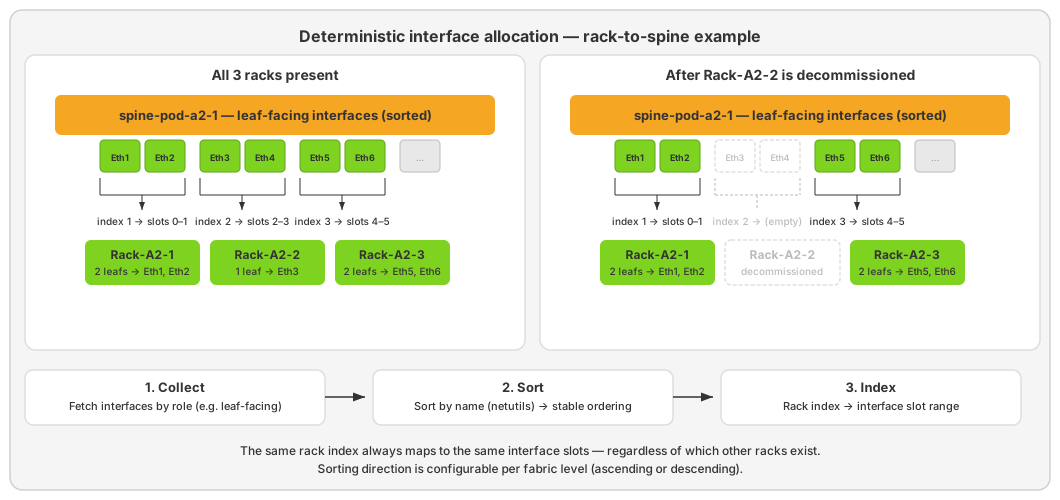
Why stability matters
Consider a pod with 4 spines and 4 racks, fully cabled. Rack-3 is decommissioned — its leaf switches and links are removed. The spine interfaces that were connected to Rack-3 are now free, sitting in the middle of each spine's used range.
If the Generator allocated interfaces by filling the next available slot, re-running it for the remaining racks would reassign them to a denser packing — shifting Rack-4's leafs onto the interfaces that Rack-3 previously occupied. In the data model, the cabling would look correct. In the physical world, those cables are already plugged in. The generated design would no longer match the actual infrastructure, and operators would need to re-cable interfaces to restore alignment.
The AI/DC solution avoids this by tying interface selection to the rack's index attribute, not to the set of racks that currently exist. Rack-4 always connects to the same spine interfaces whether Rack-3 is present or not. Decommissioning a rack leaves a gap in the interface range — which is exactly what the physical fabric looks like.
How it works
The allocation follows three steps:
- Collect — fetch all interfaces of a given role (for example, all super-spine-facing interfaces on spine devices)
- Sort — sort each device's interfaces by name using
netutils.interface.sort_interface_list, producing a stable ordering (Ethernet1, Ethernet2, ... Ethernet10, Ethernet11 — not lexicographic) - Index — use the device's position (pod index or rack index) to calculate which slot in the sorted list each cable connects to
Because the index is derived from the design object (NetworkPod.index, LocationRack.index), the same design always produces the same cabling. Re-running a Generator selects the same interfaces every time.
Pod cabling: spine-to-super-spine
Each spine connects to every super spine. The pod's index attribute determines which slot on each super spine the connections use:
- Pod with index 2 → spines connect starting at super spine interface slot 0
- Pod with index 3 → spines connect starting at a higher offset
Within a pod, each spine occupies one slot per super spine. The offset formula ensures that pods do not compete for the same interfaces — each pod owns a contiguous range of slots on every super spine device.
Rack cabling: leaf-to-spine
Each leaf connects to every spine in the pod. The rack's index attribute determines which slot on each spine the connections use:
- Rack with index 1 → leafs connect to spine interface slots 0–1 (for a 2-leaf rack)
- Rack with index 2 → leafs connect to spine interface slots 2–3
Within a rack, leaf 1 uses the first slot in the range and leaf 2 uses the second. Racks with a single leaf use only one slot.
Configurable sorting direction
The sorting direction is not hardcoded. Operators can choose between ascending (create_sorted_device_interface_map) and reverse (create_reverse_sorted_device_interface_map) per fabric level:
| Schema attribute | Controls |
|---|---|
NetworkFabric.fabric_interface_sorting_method | Super spine interface ordering |
NetworkFabric.spine_interface_sorting_method | Spine interface ordering (for pod cabling) |
NetworkPod.leaf_interface_sorting_method | Leaf interface ordering (for rack cabling) |
NetworkPod.spine_interface_sorting_method | Spine interface ordering (for rack cabling) |
This allows different cabling patterns on different fabrics — for example, one fabric might allocate interfaces top-down while another allocates bottom-up.
Idempotency
Every layer of the system is designed for safe re-runs:
| Operation | Mechanism |
|---|---|
| Device creation | allow_upsert=True — creating a device with an existing name updates rather than duplicates |
| Link creation | allow_upsert=True — creating a link with existing endpoints is a no-op |
| Interface allocation | Index-based — same design produces the same cabling plan every time |
| IP allocation | Deterministic identifiers — the resource allocator key is derived from the interface pair IDs, so the same pair always receives the same prefix |
| Checksum propagation | Deterministic hash — if nothing changed, the checksum stays the same and no downstream triggers fire |
If a Generator fails mid-run, the already-created objects remain. Re-running the Generator picks up where it left off: existing objects are upserted (no duplicates), and new objects are created. The validation gates ensure that downstream Generators do not run until the failed tier completes.
Learn more
- Design-driven automation — what the Generators read and produce
- Generator patterns — implementation-level code patterns
- EVPN/VXLAN overlay — how the OverlayGenerator layers tenant services on the fabric
- Infrahub documentation: Generators
- Infrahub documentation: Resource Manager